Beer, Because Your Friends Are Not That Interesting: What the Plastic Cup Is Really For
Somebody said it to me at an outdoor concert years ago, holding a half-full cup of something warm and yellow, and it stuck. It was a joke. It was also, I think, more or less true, and not in the mean way it sounds.
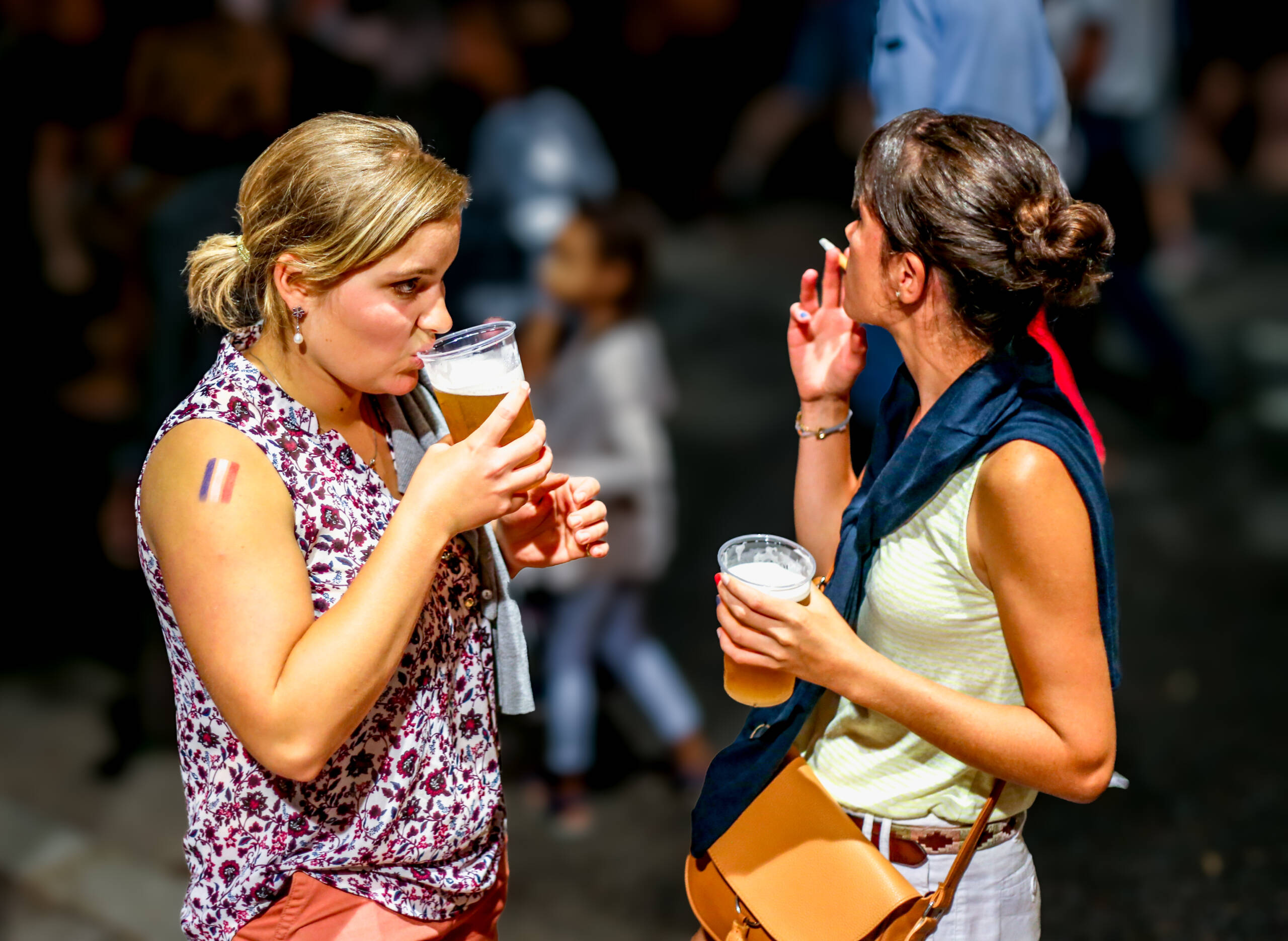
Watch people at a street festival. Two friends stand facing each other in a crowd, and there are long stretches where neither of them says anything. Not awkward silence, exactly. Just gaps. The music is loud, the crowd moves, somebody's kid runs past. What do you do with your hands and your face during those gaps? You drink. Or you smoke, which does the same job with a different prop. You look down into the cup, you take a sip you didn't want, you look up again, and the gap has been filled without anybody having to invent a sentence.
That's the actual product. The beer at these things is bad and everyone knows it. Lukewarm lager in a plastic cup with a deposit on it, poured fast by a volunteer at a folding table, four euros or seven or whatever the tent decided that year. Nobody is standing in a twenty-minute queue for the flavour profile. They're queuing for something to hold.
The prop economy
Anthropologists have a better word for this than I do, but you can see the mechanics without one. Standing around in public with nothing in your hands is uncomfortable. Your arms turn into a problem. A phone solves it but signals that you've given up on the people in front of you. A cigarette solves it and gets you a little ritual besides: the pat of the pocket, the lighter, the exhale away from your friend's face, the tap of ash. A cup solves it and lasts longer.
The cup is also a clock. You can measure a conversation by how far down the beer is. When it's empty, you have a decision point that arrives without anybody having to be rude. Another one? Or we go find the others. Nobody had to say "I'm bored." The cup said it.
And the cup gives you an exit. Getting a refill is the most socially frictionless way to leave a conversation ever invented. You're not leaving. You're getting a drink. You'll be back. (You will not be back.)
Festivals are built around this
Look at how these events are actually laid out and you'll notice the bar isn't an amenity, it's the floor plan. Beer tents at the edges of the square, so the crowd circulates. Deposit cups so people carry them instead of dropping them. Long counters instead of tables, because standing keeps groups fluid and mixing.
The organisers aren't selling you an evening of music with drinks available. They're selling you a place to stand near other people, and the drink is the ticket that lets you stand there without a reason. Take the beer away and half the crowd goes home by nine, not because they're drunks, but because there's nothing to do with the time.
Which is, I'd argue, the point of a festival. Not the band. You can hear the band better at home. The point is being in a crowd with a friend, doing very little, for four hours, and having that count as an event.
The friends are fine, actually
Here's the part the joke gets wrong. It isn't that your friends are boring. It's that continuous performance is exhausting, and the people you can be quiet with are the ones you actually like. The beer isn't covering a defect in the friendship. It's a tool that makes silence legal.
You can't sit in a café in silence for two hours. Somebody would ask what's wrong. Stand in a square with a plastic cup and a decent playlist, say six sentences over an hour, and you'll both go home saying it was a great night. And it was.
Anyway. The cheap stuff works better for this than good beer, because good beer makes you pay attention to it, and paying attention was never the assignment.
Empty cup. Your round.