The Best Room at Lisbon's Gulbenkian Museum Had One Visitor in It
I took this at 14:14 on a Wednesday in October, in the French rooms of the Calouste Gulbenkian Museum. One man, black polo shirt, hands clasped behind his back, standing in front of a painting roughly three times his height. Nobody else in the shot. Nobody else in the room either, for most of the twenty minutes I was in it.
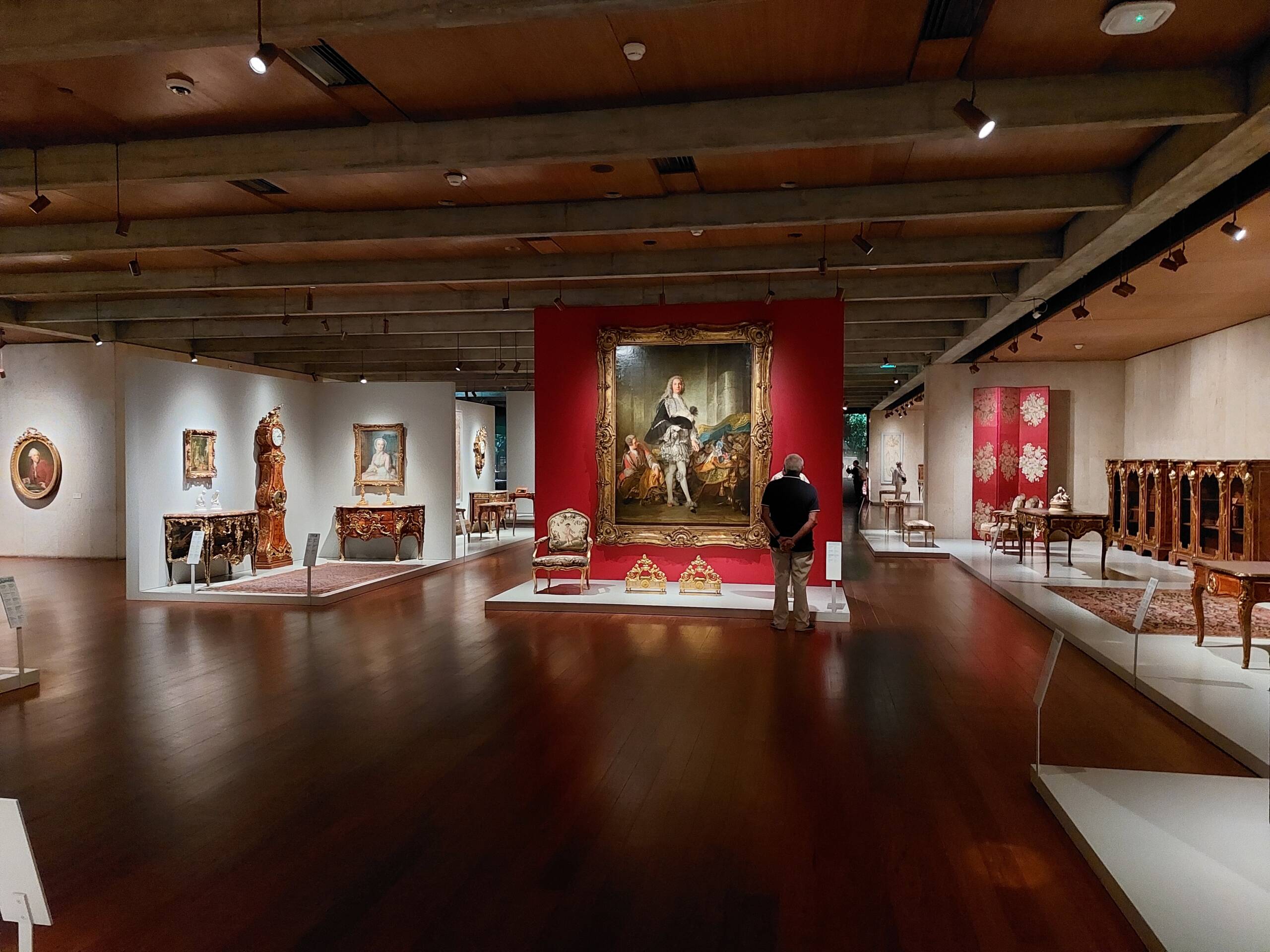
The building is the first surprise. From outside it's a low grey slab sitting in a garden, finished in 1969, board-marked concrete and long horizontal lines. Inside, the ceiling is exposed beams with wood set between them, and the floor is a deep red that looks wet under the spots. On paper that's a car park. In person it isn't. Somebody decided the objects were the point and the architecture's job was to stay out of the way without being boring about it.
Then there's the lighting, which is ruthless. The gilt commodes glow, the crimson panel behind the portrait glows, the middle of the room goes nearly black. You don't walk through the gallery so much as hop between lit islands, and the dark floor in between works like the white space around a paragraph.
Some background on why any of this exists in Portugal. Calouste Gulbenkian was an Armenian oil negotiator who talked himself into a five per cent slice of Iraqi oil and spent the rest of his life being called Mr Five Per Cent for it. He collected for decades, mostly quietly, mostly things he actually wanted in the house: Egyptian carvings, Persian manuscripts, Lalique glass, French furniture, a few Rembrandts. He saw out his last years in Lisbon, died there in 1955, and left the money and the objects together to a Portuguese foundation. So this is one man's taste made public. That's a different animal from a national collection put together by committee over two centuries, and you can feel the difference in the rooms. Nothing here is filler.
The emptiness is the part I keep thinking about. Two hours, maybe a dozen other visitors. Meanwhile in the Louvre people are holding phones over their heads to photograph the back of somebody else's head, and in the Prado you queue to get within four metres of Las Meninas. Here you get a full-length state portrait on a wall the colour of a wine stain, and you get it to yourself, and there is a chair from the same decade sitting three metres away so you can see what the sitter's furniture actually looked like.
I never found out what the man was looking at, exactly. He didn't move. He stayed put long enough for me to lift the phone, frame it, take a single shot, and put the phone back in my pocket, and he was still standing there when I walked out. Whatever the wall label said, he was well past it by then. That's the thing an empty room gives you that a good room in a busy museum never can: permission to be slow, in public, in front of one object, for as long as you feel like it.
Go on a Wednesday.