I Photographed a Wrasse at Wrocław's Afrykarium and Still Can't Name the Species
This is the best frame I got in about forty minutes of standing at the Red Sea tank in Wrocław, and I've spent longer than I want to admit trying to work out what I was looking at. Pale body, rows of small dark spots running back along the flank, faint vertical banding, a rust-coloured edge along the top of the dorsal, and a head that goes yellow-green with thin blue-white lines curving back past the eye.
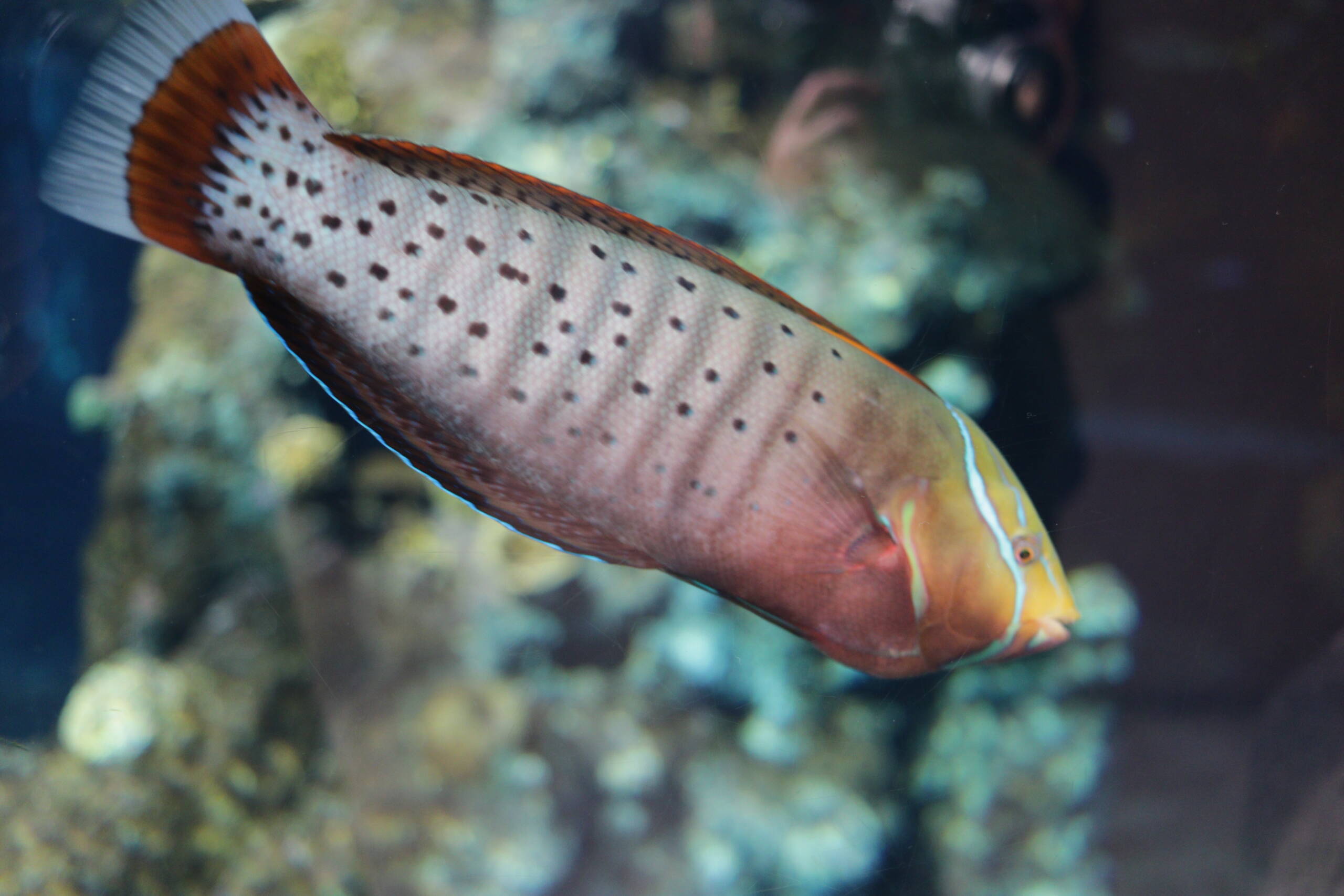
What I'm confident about: it's a wrasse, and it's almost certainly a Coris. The pointed snout, the head lines, the slightly nose-down hang in the water while it cruises, all of that says wrasse to anyone who has spent time in front of a reef tank. Past the genus I stop being useful.
There's a decent reason for that, and it's the thing I actually find interesting about this family. Wrasses don't hold one appearance for life. A juvenile, an adult female, and a fully developed terminal male of the same species can look so unrelated that nineteenth-century ichthyologists kept describing them as three different animals, which is why some of these species carry a long tail of discarded synonyms behind them in the literature. On top of that most of them are protogynous, meaning individuals start out female and some later switch to male, changing size, shape and colour as they go. So the fish in this photo isn't just hard to identify because I'm an amateur with a camera. It's hard to identify because it may be sitting halfway between two liveries that have their own separate names in old books.
The venue deserves a mention. The Afrykarium opened in October 2014 and is the only oceanarium in the world given over entirely to Africa's aquatic life, which sounds like a marketing line until you walk it and realise how much water Africa actually touches. The route starts on the Red Sea, in a coral reef tank holding a million litres and something over sixty species of reef fish, then works through the Mozambique Channel, the Congo, the great lakes, and the Namibian coast. Calling the Red Sea an African ecosystem is technically correct and still slightly rearranges your mental map, which I liked.
A note on the picture itself, since people ask. Aquarium glass is thick, curved in places, and covered in fingerprints at child height. Get the front of the lens as close to flat against it as you can, kill the flash, accept the ISO you need, then wait. You don't chase these fish. You pick a section of rock, focus roughly where you expect the pass to happen, and let the animal come to you. This one made maybe nine passes. Two were sharp.
If you know your Red Sea wrasses and you can put a species name on it, tell me. I'd rather be corrected than keep hedging.